
Virtual Assistant vs Automation Tools for Luxury Real Estate
Virtual assistance and automation are not opposite choices. One adds human execution and judgment to an approved scope. The other uses software rules to move information or trigger actions when defined conditions are met.
The right question is not which option can touch the most tasks. It is which parts of a workflow are stable enough for rules, which parts require context, and who remains accountable for the outcome. In many real estate operations, a careful combination is more useful than an all-or-nothing choice.
Compare Judgment and Repeatability
A workflow should be understood before it is automated or delegated. The table highlights practical differences without assuming a specific software product or service arrangement.
| Decision factor | Virtual assistant | Automation tools |
|---|---|---|
| Core strength | Contextual review, coordination, and procedure-led execution | Consistent execution of defined rules |
| Input tolerance | Can review incomplete inputs and request clarification | Needs predictable fields, formats, and conditions |
| Exception handling | Can assess the issue and follow an escalation path | Must route exceptions according to configured logic |
| Communication | Can adapt an approved message to context | Uses templates and programmed conditions |
| Maintenance | Training, feedback, and procedure updates | Testing, monitoring, permissions, and rule updates |
| Accountability | Assigned through role scope and review | Remains with the process owner, not the tool |
Automation can reduce repeated manual steps when inputs are consistent. It can also repeat an error consistently if a rule, field, or permission is wrong. Human review is most valuable where context changes the correct action or where an exception carries meaningful risk.
Classify Each Workflow Step
Map one workflow from request to completion. Mark the source of every input, the decision made at each step, the destination of each output, and the person responsible for exceptions. Do not start with tool features because they can encourage a solution before the process is clear.
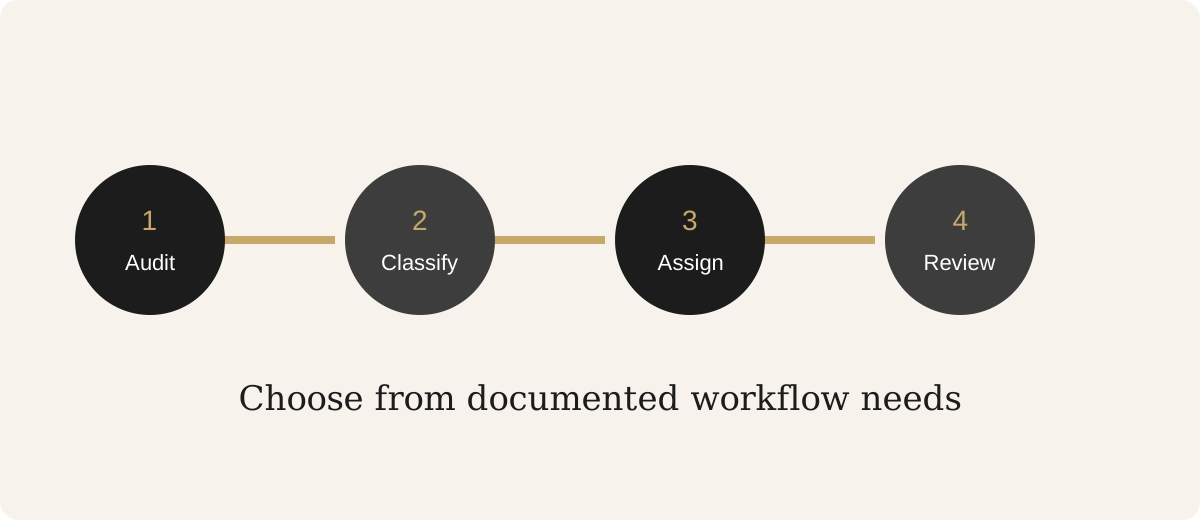
Use three practical labels:
- Rule based: The same valid input should produce the same low risk action each time.
- Review based: A person must confirm accuracy, tone, completeness, or permission before the next step.
- Judgment based: Context, material impact, or an unusual condition changes the right response.
A rule based step may be suitable for automation after testing. A review based step may pair automation with a virtual assistant or another authorized reviewer. A judgment based step should remain with the person who has the appropriate authority and expertise.
Keep a Human Owner in the Loop
Every automation needs a named owner. That person should know what starts it, which systems it changes, how failures are reported, and how to stop or reverse it when possible. Monitoring should check actual outcomes, not only whether the tool reports a successful run.
Human support also needs defined limits. A virtual assistant should know which exceptions can be resolved through an approved procedure and which require escalation. Message templates should identify where adaptation is allowed and where final approval is required.
Test changes with sample data before applying them to a live workflow. Keep access limited to the systems and actions required by the scope. Record material rule changes so the team can understand why behavior changed and restore a prior process if needed.
The Real Estate Luxury Short Answer
Use automation for stable, low risk, repeatable steps with clear inputs and observable outputs. Use virtual assistant support for coordination, quality review, exception handling, and procedure-led work that benefits from human context. Keep regulated decisions, negotiations, and material approvals with the appropriately authorized person.
The strongest design may combine both while keeping accountability clear. Contact Real Estate Luxury to discuss a support scope built around the workflows that need human ownership.
Frequently Asked Questions
Can automation replace a virtual assistant completely?
Automation can complete stable rule based steps, but it does not remove the need for ownership. A person still needs to monitor failures, review exceptions, and update the workflow when conditions change.
What should a luxury real estate team automate first?
Start with a low risk, repeatable process that has consistent inputs and a reversible output. Document the current process and assign a person to review results before expanding it.
Can a virtual assistant manage automation tools?
Yes, when monitoring and maintenance are included in the approved scope. Access, change authority, exception rules, and escalation paths should be documented before that responsibility begins.